01
Your methods apply. Your tools don't.
Contextual inquiry, usability testing, scenario design, all relevant. But robots can't be tested in a lab. Prototypes need to be physical. Failure has consequences beyond a bad rating.
The only certification program built for designers working on physical robots. Four tracks. 34 lessons. From core principles to team leadership.
What HRI design actually is
You're not designing a screen. You're designing behavior, how a machine approaches, communicates, and earns trust in physical space. Your UX skills transfer. Your assumptions don't.
01
Contextual inquiry, usability testing, scenario design, all relevant. But robots can't be tested in a lab. Prototypes need to be physical. Failure has consequences beyond a bad rating.
02
ISO 13482 requires robot interfaces to be understandable by real users. The EU AI Act classifies most deployed robots as high-risk AI. These aren't optional, they're design constraints.
03
Physical accountability, regulatory compliance, and field research with real humans in real environments, these can't be automated. That's where this curriculum focuses.
Who this is for
You have product design experience and want to apply it somewhere harder. Start with Foundation and Practitioner tracks.
You're already doing this work but piecing it together. Practitioner and Specialist tracks give you the methodology you're missing.
You know safety-critical design but not autonomous systems. Specialist track bridges that gap directly.
You need to hire, structure, and lead HRI design. The Expert track is built for exactly that.
Not sure which track to start? Take the Foundation Track. It's designed to give you everything you need to evaluate whether the field is right for you.
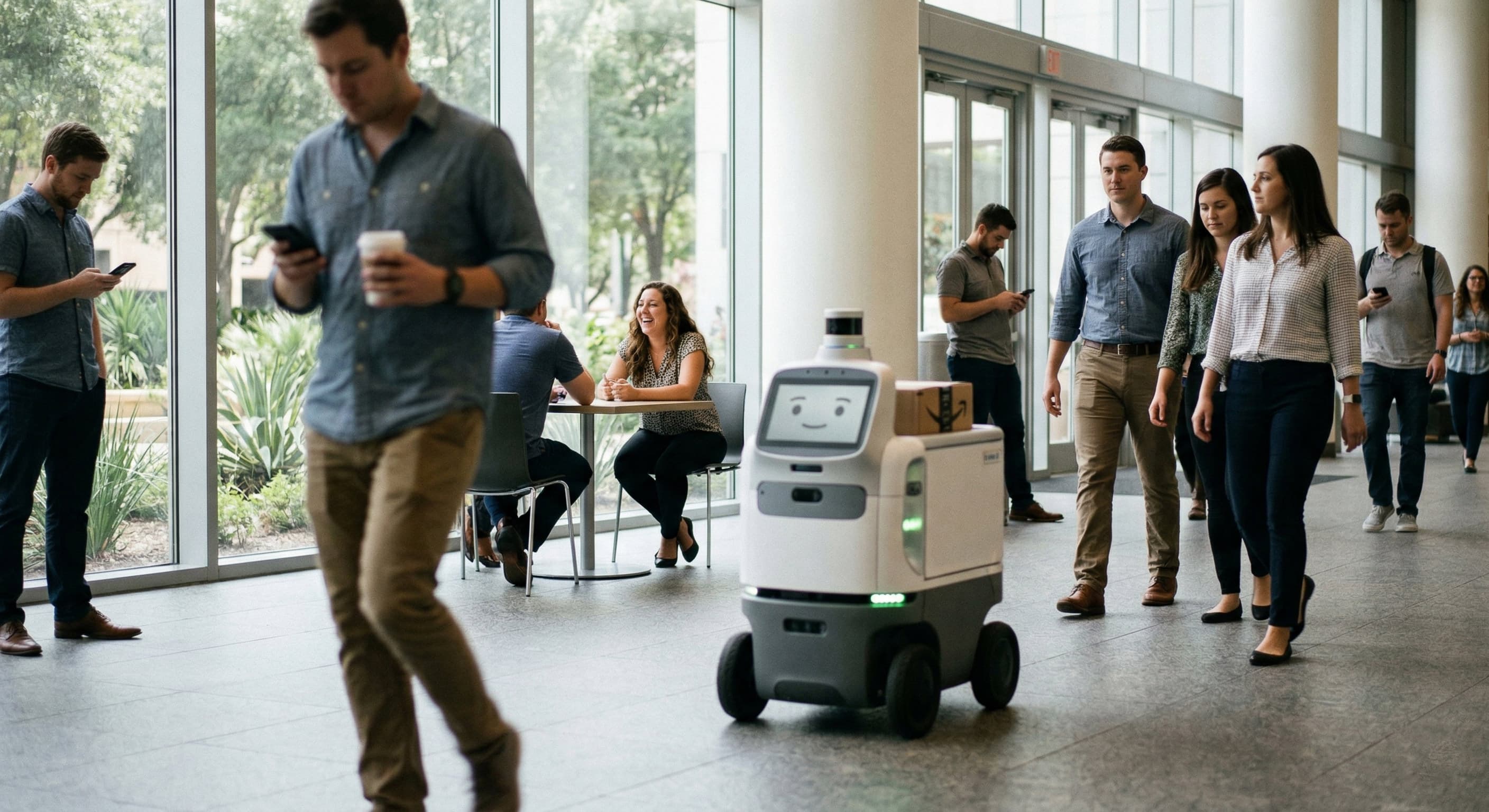
Physical context
Real HRI work lives in motion, shared space, and split attention, not just in static screens and flows.
Start with foundations and move at your own pace. Each track builds on the last.
Track overview
What HRI design is, why it differs from HCI, and the three core pillars that structure every robot-human relationship in deployed systems.
Start →Proxemic zones, approach trajectories, and spatial comfort design — how robots and humans share physical space without triggering threat responses.
Start →Robot communication across channels: sound, motion, light, and haptics — designing multimodal feedback that works in real environments.
Start →When and why anthropomorphism helps or hurts. Navigate the Uncanny Valley with purpose and understand the design decisions behind it.
Start →Trust through reliability, transparency, and graceful failure — including the critical difference between perceived safety and physical safety.
Start →Pass the final assessment to earn the HRI Foundation Certificate and verify core HRI competency.
View Certificate →Built from the field
Every lesson uses case studies from actual robot deployments, including Boston Dynamics, Amazon Robotics, Toyota HSR, hospital surgical systems, and warehouse fleets.
ISO 13482, ISO/TS 15066, and the EU AI Act are taught as engineering constraints, because that's how HRI designers at real companies have to work.
The Godspeed Questionnaire, Muir/Moray trust scales, behavioral coding, and inter-rater reliability, the actual instruments used in published HRI research.
FAQ
No. HRI design is an interdisciplinary field, the most successful practitioners come from UX, cognitive science, human factors, industrial design, and psychology backgrounds. What you need is design or research experience, and the willingness to develop basic technical literacy about how robots work (sensors, actuators, autonomy states) so you can design around their constraints. The curriculum builds that literacy progressively.
Parts of HRI design are automatable. Interaction concept generation, simulation of user responses, and optimization of motion parameters will increasingly involve AI. What AI cannot currently automate: physical fieldwork and contextual inquiry in deployed environments, regulatory accountability (you can't submit "AI designed the interaction" to the FDA), longitudinal trust research, and the organizational judgment required to manage the power dynamics between executives and frontline workers during a robot deployment. The curriculum focuses heavily on these durable competencies, not on artifact production.
Yes, and arguably more so. Most UX professionals at robotics companies are piecing together their HRI knowledge from academic papers and their own field experience. The Practitioner and Specialist tracks give you structured methodological rigor, validated measurement instruments, and the regulatory context that most practitioners are missing. The Expert track is specifically designed for people in or approaching design leadership roles.
Each certificate has a unique verification ID and a permanent public URL. Hiring managers at robotics companies aren't looking for HRI-specific credentials the way they might look for a Google UX Certificate, the field is too new for that. What they're looking for is evidence of domain knowledge and methodological rigor. The value of the certificate is the curriculum behind it: if you can speak fluently about ISO/TS 15066, design a Wizard of Oz study, and explain trust calibration, that's what gets you in the room. The certificate is how you signal it on LinkedIn before the conversation starts.
Start with Foundation. Five lessons covering the core conceptual pillars of HRI design. It costs $49 and will tell you whether this is the right direction for you before you invest in the full curriculum. If you already have significant background in physical interaction design, human factors, or prior robotics work, the Foundation will feel like a fast calibration, and the Practitioner track is where your work actually starts.
No. One payment. Lifetime access to all materials and future updates within your purchased tracks.
Pricing
One-time payment. Lifetime access. Certificate issued on completion.
One-time payment
Five lessons. One-time payment. The right place to start if you want to understand the field before committing to the full program.
One-time payment
All 34 lessons across all four tracks. Four verifiable credentials. For designers building HRI as a serious professional practice.
No subscription. No recurring fees. Lifetime access.
Five lessons. $49. A clear picture of what HRI design is and whether this is where you're headed.
Begin Foundation Track, $49 →